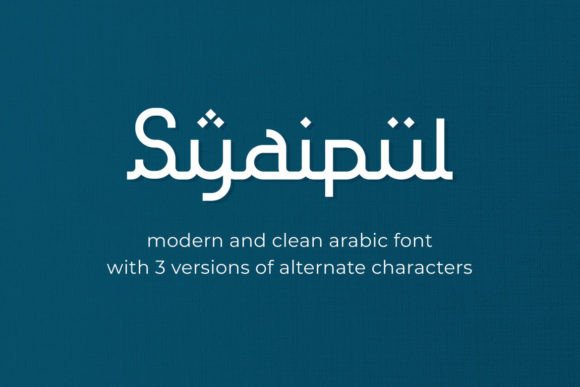
Syaipul Arabic Display Font for Elegant Branding
Last Tuesday, I helped a local candle maker finalize her new seasonal packaging—hand-poured soy candles with names like “Oud & Amber” and “Nile Jasmine.” She’d spent weeks sourcing eco-friendly jars and custom-printed labels, but the moment she opened her design file, something felt off. The Arabic calligraphy on her front label—meant to echo the heritage behind her family’s fragrance recipes—looked stiff, dated, and disconnected from the rest of her clean, modern aesthetic. That’s when we swapped in Syaipul. Within minutes, the whole label softened, elevated, and breathed with intention. That’s the quiet power of the right Arabic display font.
Syaipul for Ramadan Greeting Cards and Small Business Thank-You Notes
If you run a bakery, boutique, or handmade shop that sends out seasonal cards—or even just heartfelt thank-you notes with orders—you know how much weight a single line of Arabic text carries. With Syaipul, those greetings don’t just say “Ramadan Mubarak”—they say “we made this with care.” Its graceful curves, balanced spacing, and subtle contrast give warmth without sacrificing clarity. I tested it printed at 14pt on kraft thank-you cards (yes, real paper, not digital previews), and every letter held its shape—even the delicate dots and diacritics. As a display font, Syaipul isn’t meant for long paragraphs, but for short, meaningful phrases: a blessing, a brand motto, a product name in Arabic script. It works beautifully alongside simple sans serif fonts like Montserrat or Inter for bilingual layouts—no design degree required.
Syaipul for Book Titles and Editorial Branding in Print and Digital
A friend who publishes small-run poetry chapbooks asked me to review her cover mockups. Her current Arabic title font looked like it belonged in a textbook—not a lyrical, intimate collection. Syaipul changed everything. Its elegance feels intentional, not ornamental. It has presence without shouting—perfect for book titles, magazine headlines, or even Instagram story covers where tone matters as much as legibility. Because it’s a display font, it shines brightest at larger sizes (24pt and up), but still holds up well at 18pt on A5 flyers or digital banners. Just avoid using it below 14pt in print or on mobile thumbnails—it’s designed to be seen, not scanned. As one of the few premium fonts built specifically for modern Arabic editorial use, Syaipul bridges tradition and today’s visual language in a way that feels authentic, not performative.
Syaipul for Banners, Flyers, and Social Media Graphics
We used Syaipul to redesign a neighborhood café’s monthly event flyer—think “Quran Recitation Night” and “Iftar Gathering” in bold, centered headers above minimalist illustrations. The font gave instant gravitas without heaviness. On Instagram, we dropped the same headline into a Reel thumbnail—and yes, people paused. That’s the difference a strong display font makes: it slows the scroll, signals quality, and quietly says “this matters.” For banners and digital ads, Syaipul pairs especially well with neutral sans serifs (like Poppins or Lato) or light serif companions (like Playfair Display). No need to overcomplicate it—just set your Arabic headline in Syaipul, your English subhead in a clean supporting font, and let the contrast do the work. And because it’s a commercial font, you’re covered for client work, merch, and online shop banners—as long as you check the license includes multi-user or extended use if needed.
Syaipul for Product Labels, Packaging Design, and Boutique Tags
This is where Syaipul really proves its worth for small business owners. Think: skincare serum bottles, spice blend jars, hijab packaging, or artisanal date boxes. Its refined proportions make Arabic script feel luxurious—not decorative, not gimmicky, but deeply considered. I’ve seen it work on matte-finish sticker labels (with crisp ink coverage) and foil-stamped gift tags (where its fine strokes catch the light just right). As a display font, it’s best reserved for primary product names or key descriptors—not ingredient lists or fine print. For those, pair it with a highly legible sans serif. Also worth noting: before finalizing any production run, double-check that your version of Syaipul includes full Arabic glyph support, basic ligatures, and OpenType features—most reputable sellers include these, but it’s always smart to preview the character map first. And yes, it’s licensed for commercial use, so you can confidently use it on physical products, digital templates, and client branding projects.
Typography isn’t just about looking pretty—it’s about signaling who you are before a customer reads a word. Syaipul gives Arabic-speaking brands and inclusive businesses a way to express elegance, reverence, and modernity all at once. Whether you're updating a menu, designing a limited-edition Ramadan box, or building a cohesive brand identity across platforms, this display font delivers polish, personality, and quiet confidence. It’s not flashy—but it’s unforgettable.